
Aero Escape
Gimica GmbHCasual
3.81.36K Reviews
- Version
- 1.4.0
- Installs
- 500.00K
- Age Rating
- Everyone
Screenshots
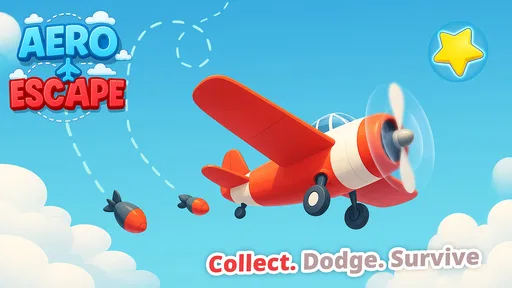

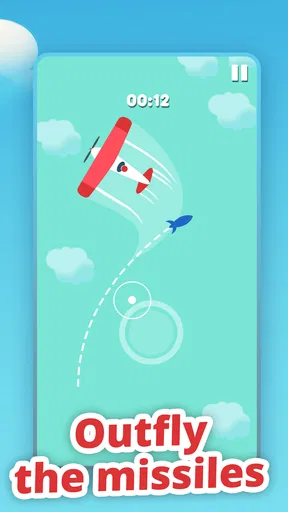

Our Review of Aero Escape
 Analysis by Appyee
I approached Aero Escape as the kind of casual game you open when you have a few spare minutes and want something immediately understandable. Its central challenge is simple: keep an aircraft clear of incoming missiles while collecting stars and reacting quickly to danger. That simplicity is the point, but it also makes the quality of the moment-to-moment control especially important. There is nowhere for a complicated progression system to hide a weak response.
After spending time with it, my view is fairly clear. This is best suited to players who enjoy short reflex challenges, quick restarts, and the satisfaction of improving through practice rather than building a long-term character or exploring a large world. It is free, rated for Everyone, and made by Gimica GmbH, so it is easy to approach as a light game for a broad audience. I would recommend trying it if you want a focused arcade-style diversion, but I would not choose it for a deep casual experience with extensive customization or a substantial narrative.
What to consider before choosing Aero Escape
I’d use this section to decide whether the game’s quick, reaction-heavy rhythm suits the moments when you usually reach for your phone. I’d also weigh its narrow focus against what you want from a casual game: a repeatable skill challenge, or a broader mix of activities that stays fresh through variety.
The real decision is about the type of attention you want to give
The first question is not whether the premise sounds appealing; it is whether you enjoy games that ask for concentration in small bursts. Missile-dodging games can feel exciting because every movement matters, yet they can also become tiring when the challenge depends on repeated reactions. I found that the best sessions were short ones, especially when I treated each attempt as a chance to refine my timing rather than expecting a long play session.
The star-collecting objective adds a useful second layer. Avoiding missiles keeps you alive, while collecting stars gives you a reason to take risks instead of simply staying in the safest area. That creates a small but meaningful decision each time a star appears: do I move toward it and expose myself to danger, or do I preserve the current run? For a casual game, that risk-and-reward choice gives the basic loop more personality than simple survival alone.
I would also consider your preferred control style. A game built around aerial movement and incoming hazards lives or dies by how quickly you can translate an idea into an action. If you prefer slow planning, puzzle solving, or turn-based choices, this may feel too reactive. If you like watching a pattern develop and making a quick correction at the right moment, the premise is much more attractive.
Short sessions are a strength, not a missing feature
I see the game working particularly well during ordinary gaps in the day: while waiting for transport, during a short break, or when I want to clear my head without committing to a long campaign. The structure encourages me to start quickly, focus on the immediate hazard, and stop when my attention drops. That makes it more practical than a larger casual game that expects me to remember a map, a quest, or a complicated upgrade path.
There is a trade-off, though. Players who want a strong sense of long-term progression may find the repeated loop limited. The appeal comes from better reactions and more confident decisions, not from an elaborate journey. I would therefore judge it by the quality of its short challenges rather than by the amount of content I expect from a full-scale mobile game.
What the audience and popularity suggest
The game has an average rating of 3.8 from around 20 thousand ratings, with roughly 1.4 thousand written reviews. It has also passed 500 thousand installs. Those figures suggest that it has found a substantial audience while still producing a mixed enough response to encourage realistic expectations. I would read that as a reason to try it personally rather than assuming it will suit everyone.
It is available at no cost, which lowers the barrier to testing the controls and deciding whether the loop holds your attention. The age rating of Everyone also makes it a straightforward option for households looking for a simple reflex game. The release date was September 26, 2025, and the current version is 1.4.0, so I would make sure my device meets the stated minimum of Android 7.0 before installing.
Where the game earns its place
For me, its lasting value comes from having a clear role rather than trying to be an all-day game. I’d keep it in rotation for brief breaks when I want active concentration, while choosing something slower or more varied when I have time for a longer session. The next section looks at how that focused role can fit into an ordinary routine.
The premise becomes more interesting when you chase stars
The strongest design choice is the tension between safe movement and greedy movement. If the only goal were to dodge missiles, the optimal approach could become overly cautious. Stars encourage me to leave a comfortable position and think about the next few seconds rather than only the threat directly in front of me. That makes each run feel like a series of small judgments instead of a single reflex test.
One practical tip is to avoid treating every star as mandatory. Early in a run, I may accept a risky approach because it teaches me how much room I have to maneuver. Later, when a run is going well, skipping a badly positioned star can be the smarter decision. This is one of the game’s less obvious lessons: collecting more is not automatically better if the movement needed to do it leaves no recovery option.
I also found it useful to watch the open space around the aircraft rather than staring only at the nearest missile. Looking at the next safe route gives me more time to react. That habit matters because last-second movements tend to create a second problem immediately after the first one. The game rewards anticipation, even though its surface presentation is simple.
It is easy to understand without feeling completely empty
The basic objective can be explained in one sentence, but the interaction between survival, movement, and collection gives it enough texture for repeat attempts. I do not need to learn a large ruleset before playing. I can begin with the obvious goal, then gradually improve by noticing how my choices affect the next hazard.
That makes it a good introduction to reflex-based games for someone who does not usually play them. A younger or less experienced player can understand the immediate task, while a more practiced player can set personal goals around cleaner movement and better risk management. The Everyone rating supports that broad accessibility, although the intensity of repeated failure may still frustrate players who dislike reaction-based challenges.
The compact loop works well for everyday use
Imagine having seven or eight minutes before an appointment. A story-heavy game may be inconvenient because you could interrupt a conversation, lose track of a task, or stop at an awkward point. Here, the central activity is focused enough to fit into that kind of gap. I can play one attempt, learn from a mistake, and put the phone away without feeling that I have abandoned a larger commitment.
That same quality helps when I want a mental reset. Concentrating on the aircraft and the missile paths gives my attention a clear target. I would not call it a relaxation game in the traditional sense, because the pressure can build quickly, but it is a useful alternative to passively scrolling. The important condition is knowing when to stop; after several frustrating attempts, another run may no longer feel refreshing.
Small habits make a noticeable difference
My most useful approach was to separate practice from score chasing. In practice-minded runs, I focused on understanding movement and learning when a star was too dangerous to pursue. In score-minded runs, I accepted that a mistake would end the attempt and concentrated on maintaining a calm rhythm. Mixing those goals every few seconds made me play more impulsively.
I would also keep the phone position consistent. Because the game depends on quick reactions, changing how I hold the device can make familiar movements feel less reliable. A stable grip and an unobstructed view reduce unnecessary friction. This is not a hidden feature, but it is the kind of practical adjustment that can improve the experience more than repeatedly blaming the game for a missed maneuver.
Another useful trade-off is deciding whether to prioritize immediate safety or future positioning. A quick escape from one missile may place the aircraft directly in the path of another. When I instead moved toward a wider area, I sometimes gave up a nearby star but gained more options afterward. That broader view makes the game feel less random and more like a test of planning under pressure.
The main limitations are tied to its narrow focus
The same simplicity that makes the game approachable can make it feel repetitive for players who need frequent changes of pace. Its appeal depends heavily on whether dodging, collecting, and trying again remain satisfying over time. If you expect new mechanics, a broad world, or a strong narrative arc, the basic loop may not provide enough variety.
I also think the game can be unforgiving in a way that casual players will either enjoy or reject. A reflex challenge naturally punishes hesitation, but repeated mistakes can feel discouraging when I am not sure whether I failed because of a poor decision or a late reaction. The best way to handle that friction is to view each run as information. If that mindset does not appeal to you, a gentler casual game may be a better match.
Who should choose it and who should look elsewhere
I would point this game toward someone who likes arcade challenges, wants a free distraction, and enjoys improving through repetition. It is also a reasonable choice for a player who wants an accessible game that can be understood quickly without learning a complicated progression system. The broad age rating makes it suitable for a wide range of players, provided they are comfortable with fast reactions and repeated attempts.
I would steer competitive players toward a more feature-rich alternative if they need extensive rankings, team play, or a deep collection system. I would do the same for players who prefer relaxing games with little pressure. Someone looking for a story-driven experience should also skip this one, because the attraction is the immediate flight challenge rather than a larger fictional journey.
How it compares with familiar casual alternatives
Compared with endless runners, Aero Escape puts more emphasis on aerial avoidance and deliberate positioning than on following a forward path. That can feel more open and less predictable, but it may also be harder to read for someone accustomed to fixed lanes. Compared with puzzle games, it offers faster feedback and less time to think, trading careful problem solving for instant reactions.
Compared with idle or simulation games, it demands active attention from the first moment. There is no appeal in leaving it running while doing something else; the experience depends on the player’s decisions. That makes it a better fit for a short burst of engagement, while an idle game may be preferable when you want progress with minimal input.
Traditional arcade alternatives may offer more variety, but that does not automatically make them better. If I want one clean idea that I can return to without remembering a complicated system, the focused design here is an advantage. The choice comes down to whether you value a concentrated reflex loop or a larger menu of modes and mechanics.
What switching to it really involves
The financial cost of trying it is low because the game is free. The bigger cost is attention: you need to learn its movement rhythm and accept that improvement may come through several failed attempts. If you are moving from a slower casual game, the first adjustment is learning to plan around danger before it reaches the aircraft rather than reacting only when it is close.
There is also a habit cost. Players who are used to collecting every visible item may need to accept that a star can be a trap from a strategic point of view. The game becomes more enjoyable when I stop measuring success only by what I collect and start considering whether each move leaves a safe next move. That change in mindset is small, but it determines whether the loop feels thoughtful or merely hectic.
For a new player, I would begin with short sessions and deliberately allow a few conservative runs. Use them to understand how much space is needed to change direction and how quickly a risky route becomes unrecoverable. Once movement feels familiar, introduce more ambitious star collection. This gradual approach is less frustrating than trying to maximize everything immediately.
My recommendation after weighing the trade-offs
Aero Escape is worth downloading if you want a free, compact casual game built around dodging missiles, collecting stars, and sharpening your reflexes. I like that the objective is immediately clear while still giving me meaningful choices about risk. The current version, 1.4.0, and its support for Android 7.0 or later make it accessible to many Android users, and its Everyone rating broadens its appeal.
My recommendation is more cautious for anyone seeking depth. The game’s value is in the quality of each short attempt, not in a large progression journey. If you enjoy repeating a focused challenge and learning from mistakes, it can become a dependable time filler. If you need a narrative, extensive customization, or a calmer pace, choose another casual category instead.
In the end, I see this as a game to keep available for specific moments rather than an all-purpose mobile favorite. When I have a few minutes and want something active without a long setup, it makes sense. When I want a richer experience, I would switch to a more substantial alternative. Choose it for quick reflex practice and risk-based flying, not for a deep campaign.
Verdict
Strengths of Aero Escape
- Simple controls make the game easy to pick up.
- Short levels suit quick gaming sessions.
- Bright visuals give the game a cheerful look.
- Increasing difficulty keeps later stages engaging.
- Offline play is convenient when no connection is available.
Limitations of Aero Escape
- Repetitive gameplay may become tiring after extended sessions.
- Some challenges can feel frustrating without clear guidance.
- Limited content may reduce long-term replay value.
- Ads can interrupt the experience between attempts.
- Progression may feel slow for players seeking faster rewards.
Other Releases by Gimica GmbH
View All


Similar Picks in This Category
View All
My Talking Angela
Outfit7 Limited4.2

My Talking Tom
Outfit7 Limited4.3

Pou
Zakeh4.2

My Talking Tom 2: Pet Game
Outfit7 Limited4.3

Candy Crush Saga
King4.6

Bridge Race
Supersonic Studios LTD4.1
Frequently Asked Questions
What is Aero Escape, and how does the game work?
Aero Escape is an arcade-style flying game focused on quick reactions, obstacle avoidance, and score chasing. Players control an aircraft through increasingly challenging environments while trying to collect rewards and stay airborne. The controls are generally easy to understand, but the pace can become demanding quickly, making it suitable for short sessions as well as longer attempts to improve a personal high score.
Is Aero Escape free to download and play?
Aero Escape can generally be downloaded at no initial cost, although the exact availability may depend on whether you are using Android or iOS. Like many free mobile games, it may include advertisements, optional in-app purchases, or both. It is worth checking the store listing before installing, especially if you want to understand whether purchases remove ads, unlock content, or provide gameplay-related bonuses.
Does Aero Escape require an internet connection?
The basic flying gameplay in Aero Escape may be playable without a constant internet connection, which is convenient when travelling or when mobile data is limited. However, certain features—such as advertisements, online rankings, cloud synchronization, updates, or promotional content—may require connectivity. For the most reliable experience, launch the game once while online and review its permissions and store information.
Is Aero Escape suitable for children and beginners?
Aero Escape is relatively accessible for beginners because its main concept is simple: control the aircraft, avoid hazards, and survive for as long as possible. Nevertheless, the increasing speed and repeated attempts may make it challenging for younger players. Parents should also review the game’s advertising, in-app purchase options, privacy information, and age rating before allowing children to play.
What should I know about Aero Escape before downloading it?
Before downloading Aero Escape, check that your device meets the current Android or iOS requirements and that enough storage space is available for the installation and future updates. Gameplay is best suited to players who enjoy reflex-based arcade challenges rather than a long story campaign. Also review the latest store description, permissions, advertisements, and purchase details because these elements can change between versions.
Play our best games!


